

Picture this: a potential customer searches for exactly what you offer, clicks your link, and waits. Three seconds. Five seconds. The page barely moves. Without a second thought, they hit the back button and land on a competitor’s website that loaded in under a second.
That’s not a hypothetical. That’s a business losing customers to a rival every single day. And in 2026, with user expectations higher than ever, a slow website isn’t just a technical inconvenience, it’s a financial liability.
This article breaks down the real cost of poor website performance, backed by the latest data, and explains why website maintenance isn’t an expense, it’s an investment. If you’re running a business that depends on its online presence, this is essential reading.
The Numbers Don’t Lie: What Slow Load Times Actually Cost
Before we talk about solutions, let’s understand the scale of the problem. The data from 2025 and 2026 is stark.
A one-second delay in page load time can reduce conversions by up to 20% and that impacts compounds. At five seconds versus one second, you’re looking at conversions dropping by 35%. That’s not linear. That’s a cliff.
Meanwhile, Amazon and Akamai research has consistently found that for every 100 milliseconds of delay, businesses see a 1% revenue drop. For a company doing £1 million annually, a single second of slowness could cost £70,000 or more in lost conversions each year.
These aren’t edge cases. They’re the lived reality of businesses operating with unmaintained, underperforming websites.
What Users Actually Expect
Nearly half of all users expect a page to fully load within two seconds. And 53% will leave entirely if it takes more than three seconds. On mobile, where the majority of web traffic now originates, the average load time is still 1.9 seconds, but the tolerance for failure is even lower.
In 2026, where 5G and advanced broadband are the norm, users aren’t forgiving. They’ve been trained by the internet’s fastest experiences, and anything slower feels broken.
Your SEO Rankings Are Taking a Silent Hit
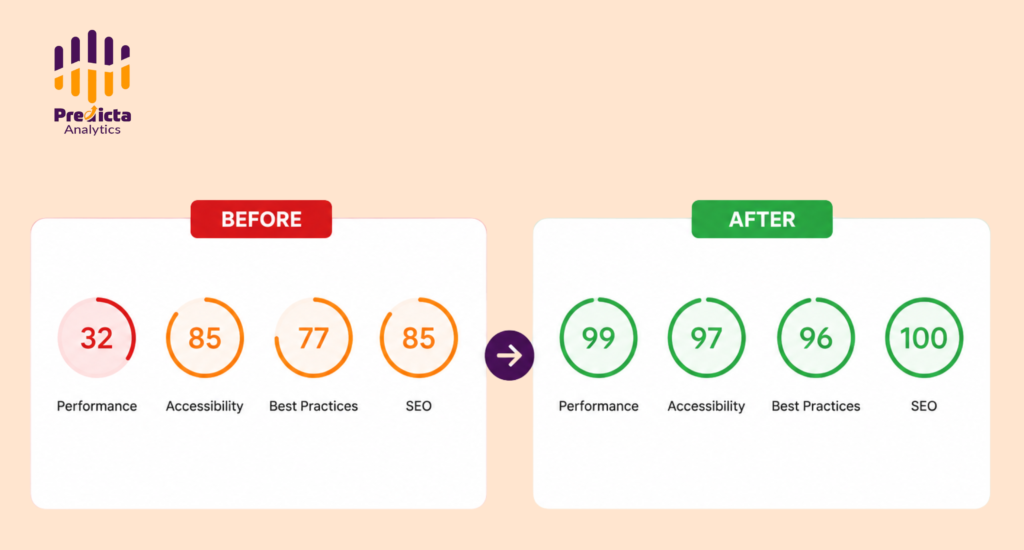
Google has been explicit about this for years: site speed is a confirmed ranking factor. But many business owners still treat it as optional. Google’s Core Web Vitals – which measure Largest Contentful Paint (LCP), Interaction to Next Paint (INP), and Cumulative Layout Shift (CLS) are now baked into how your site ranks.
The targets are clear: your LCP should be under 2.5 seconds. Anything over 4 seconds is rated poor, and Google treats it accordingly.
Here’s what the empirical data shows:
• Pages loading under 2 seconds rank 15-20% higher than pages taking 5+ seconds
• 82% of top-ranking pages (positions 1-10) score 90+ on PageSpeed Insights
• Only 43% of pages in positions 11-20 hit that same benchmark
The relationship is consistent: faster pages climb, slower pages stagnate or slide.
There’s also the crawl budget problem. Google’s search bots have a limited crawl budget per site. When your pages load slowly, Google indexes fewer of them less frequently. Your carefully crafted content simply doesn’t get seen, not because it isn’t good, but because the technical foundation is failing it.
The Invisible Damage: Trust, Perception, and Brand Reputation
Beyond rankings and conversions, there’s a softer but equally serious cost: how users perceive your brand.
A slow website in 2026 sends a message before a single word is read. It says: this business doesn’t care about the experience of its customers. In a world where 83% of customers say experience is as important as the product itself, that first impression matters enormously.
Users don’t leave complaints. They simply don’t come back. They don’t email you to explain why. They just quietly choose someone else – and sometimes, they share that experience with colleagues, in reviews, or on social media.
The reputation damage from a poorly maintained website accumulates invisibly until it becomes a visible problem: declining traffic, stagnant leads, or a client mentioning during a meeting that your website seems “a bit slow.”
What’s Actually Causing Your Website to Slow Down?
Most website performance issues trace back to a handful of well-understood causes. The good news: they’re fixable. Here’s what typically drives slowness:
1. Unoptimised Images
Large image files are one of the most common performance killers. Converting images to modern formats like WebP can dramatically reduce file size without any visible loss in quality. Many websites are still serving JPEG files uploaded years ago, adding unnecessary weight to every page load.
2. Outdated Plugins and Software
Every plugin installed on your site adds code that must be processed. Outdated plugins are both a performance risk and a security vulnerability. Regular audits to remove what’s unused and update what remains are essential hygiene not optional extras.
3. No Content Delivery Network (CDN)
Without a CDN, your site is served from a single server location. Visitors geographically distant from that server experience noticeably slower load times. Services like Cloudflare distribute your content across global nodes, reducing the physical distance between your site and your visitors.
4. Bloated Code and Unminified Files
Every unnecessary line of CSS, JavaScript, and HTML adds to the number of requests your browser must process. Minifying and combining these files is a straightforward technical fix that delivers immediate speed gains.
5. Poor Hosting Infrastructure
Budget shared hosting might save money upfront, but the cost in lost performance and therefore lost revenue often far exceeds the savings. Hosting is infrastructure, and infrastructure has to be adequate for the load it carries.
6. Lack of Browser Caching
When a user returns to your site, caching allows their browser to store key files locally rather than re-downloading everything. Without it, every visit starts from scratch, adding unnecessary load time for your most engaged, returning visitors.
Website Maintenance Is Infrastructure, Not a Cost
There’s a common misconception that website maintenance is an optional expense, something you think about when things break. The reality is the opposite.
A maintained website is performing infrastructure. Like the physical premises of your business, or the tools your team uses every day, neglecting it doesn’t save money, it defers the cost while the underlying problem compounds.
An annual audit, ongoing performance monitoring, regular software updates, and proactive security management aren’t luxuries. They’re what separates a website that works for your business from one that silently works against it.
The most successful businesses treat their website the same way they treat their most important business asset: with ongoing care, measurement, and improvement. As confirmed by Google PageSpeed Insights documentation, regular performance reviews catch regressions before they affect rankings or revenue.
The Bottom Line: This Is the Right Time to Act — And Here’s Why

At Predicta Analytics, we work with businesses on exactly this: turning underperforming websites into assets that actually pull their weight.
And right now, with EOFY here, we’re offering something worth paying attention to.
Pay for 10 months of website maintenance and get 12. Two months free. No hidden conditions.
It’s designed for businesses that are ready to stop reacting to website problems and start preventing them — with a team watching your performance, keeping everything updated and optimised, and flagging issues before your customers find them first.
Your competitor is hoping you’ll wait until after the financial year. Don’t.
Get in touch with the Predicta Analytics team and let’s make sure the next visitor who finds you actually stays.
Frequently Asked Questions
Website speed is a confirmed ranking factor through Google’s Core Web Vitals. Pages that load under 2 seconds consistently rank 15–20% higher than those taking over 5 seconds. Beyond rankings, slow load times reduce how frequently Google crawls your content, meaning new pages and updates take longer to appear in search results.
Google recommends a Largest Contentful Paint (LCP) score of 2.5 seconds or better. Full interactivity should be achievable within 1 second. As a practical benchmark: if your site takes more than 3 seconds to load on mobile, you are losing a significant portion of visitors before they see a single line of content.
The simplest starting point is Google PageSpeed Insights (free) and Google Search Console’s Core Web Vitals report. These tools provide both a technical score and real-user performance data, showing where your site is losing speed and why.
Absolutely. The conversion impact is often larger than the ranking impact. A 1-second delay can reduce conversions by up to 20%. At 5 seconds versus 1 second, the gap widens to around 35%. For an e-commerce or lead-generation site, these losses translate directly to revenue.
Image compression (converting to WebP format), enabling browser caching, and removing unused plugins typically deliver the fastest gains. For sites serving a global audience, adding a CDN like Cloudflare is often the single highest-impact change. However, sustainable performance requires ongoing maintenance, not a one-time fix.
Core tasks: software updates, security scans, performance monitoring, should happen continuously in the background. A full technical audit, including speed optimisation review, broken link checks, and plugin audit, should occur at minimum quarterly. High-traffic or e-commerce sites benefit from more frequent attention.
For most small to medium businesses, yes. The cost of a dedicated in-house team typically exceeds the value derived, particularly when the ongoing need is maintenance rather than active development. A managed maintenance service provides expert coverage at a fraction of the full-time cost — and ensures issues are caught before they affect customers or rankings.
The average cost for website design in Australia is between $5,000 to $10,000+ for a 6 – 10 page website.
For most small businesses in Australia, a realistic budget for website maintenance is between $1,200 and $3,000 per year.