
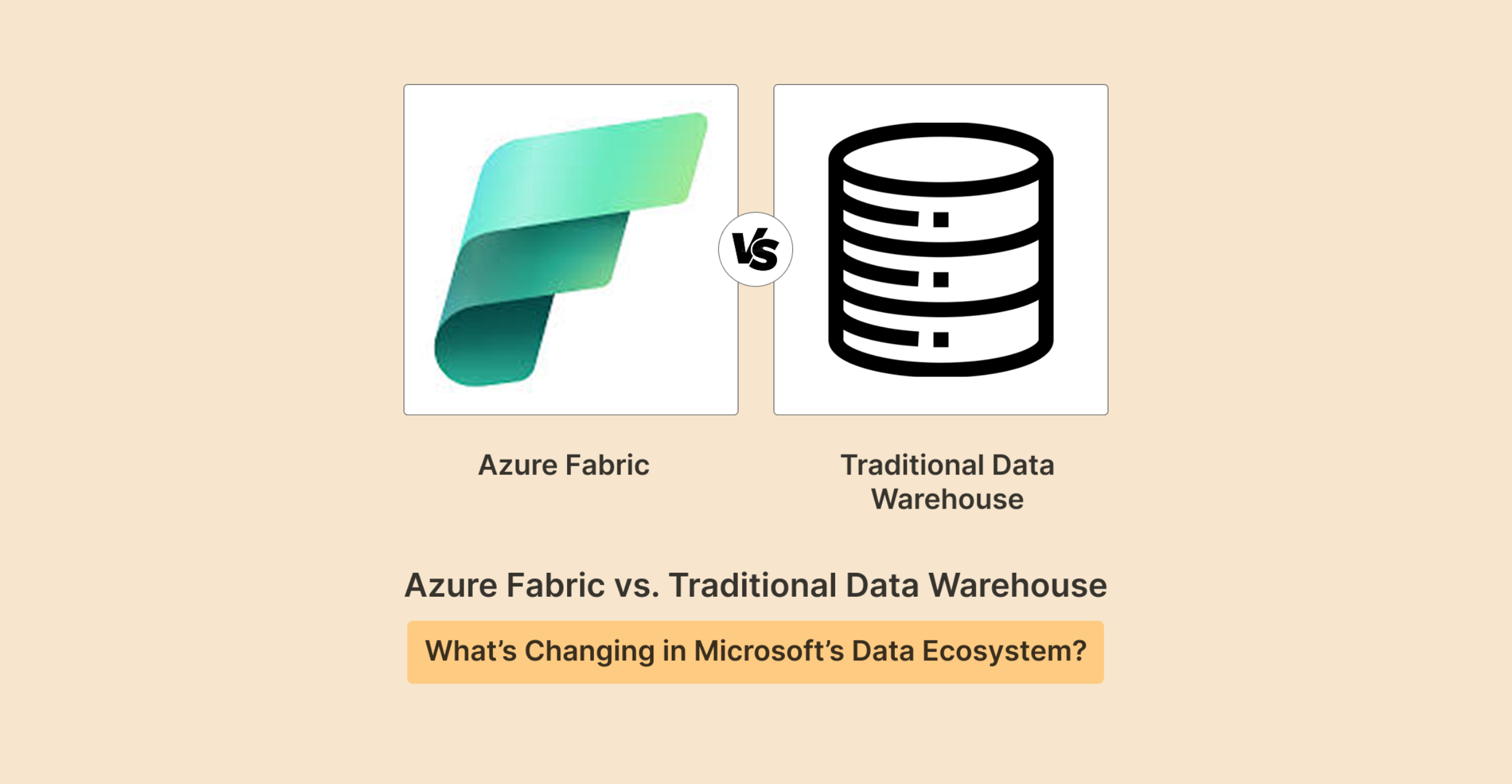
Azure Fabric vs. Traditional Data Warehouse: What’s Changing in Microsoft’s Data Ecosystem
If you’ve been in business long enough, you’ve probably lived through at least one “data revolution.”
You might remember the excitement when the first dashboards began lighting up in Power BI. Or when your company finally moved from spreadsheets to a modern cloud data warehouse. Those were big steps and for a while, they seemed like the finish line.
But now, something new is on the horizon.
Microsoft has reimagined how data, analytics, and AI come together — and they’ve called it Microsoft Fabric. It’s not just an upgrade. It’s a complete rethink of how businesses will work with data in the years ahead.
And for many business leaders, it raises an important question:
What’s the real difference between Azure Fabric and the traditional data warehouse we already have?
Let’s unpack that, one story at a time.
The Old World: Traditional Data Warehouses
Think back five or ten years. Your business data likely lives across multiple systems – your CRM, finance tools, ERP, and maybe a few thousand spreadsheets hiding on people’s desktops.
To make sense of it all, IT teams built data warehouses. These became the central place to store and organise your company’s most important information.
It worked, mostly.
Every few hours, data would be extracted, transformed, and loaded into your warehouse. Analysts would connect Power BI or another BI tool to it and build reports. Business leaders would review dashboards over coffee and make decisions for the week ahead.
It was structured, stable, and predictable. But it also had limits.
When new datasets appeared or the business needed real-time insights, the warehouse lagged.
When teams wanted to bring in unstructured data, social sentiment, IoT feeds, or clickstream data, the warehouse struggled.
And when AI started entering the picture, traditional data warehouses weren’t ready for that kind of workload.
That’s where Microsoft Fabric begins to change the story.
Enter Microsoft Fabric: The All-in-One Data Platform
Imagine if, instead of stitching together multiple systems, data warehouses, data lakes, integration tools, and reporting services, everything lived in one unified environment.
That’s exactly what Microsoft Fabric brings to the table.
Fabric isn’t just a rebrand of Azure Synapse or another BI add-on. It’s a full platform that integrates data movement, data engineering, data science, real-time analytics, and business intelligence into a single experience.
What this means for business users is simple:
- No more juggling multiple tools. Whether your data team is cleaning raw information, building machine learning models, or designing Power BI dashboards, it all happens within Fabric.
- Faster insights. Data flows in real time from your apps and services, so executives aren’t waiting hours or days for refreshed reports.
- AI-powered intelligence. With Azure OpenAI and Copilot embedded within Fabric, natural language can now drive exploration — “Show me where our sales numbers are softening this quarter” becomes an interactive conversation, not a query to IT.
- One source of truth. Instead of different teams working from different data silos, everyone collaborates in one consistent environment.
To use a simple analogy:
If your old data warehouse was like a library where information was neatly stored on shelves, Microsoft Fabric is more like a living knowledge hub data is continuously curated, connected, and made intelligent.
What’s Driving the Change?
At Predicta Analytics, where we specialise in Microsoft BI consulting and Power BI Managed Service solutions, we’ve seen a clear shift in how businesses think about data.
Five years ago, the goal was mostly about reporting the past.
Today, it’s about predicting the future and taking action in the present.
This shift calls for more than just faster queries – it demands a system where analytics, machine learning, and operational data can work hand in hand.
That’s why Microsoft created Fabric: to bring together what used to be separate worlds, storage, analytics, and AI under one umbrella.
A Real-World Example: From Disconnected Data to Connected Decisions
Let’s look at what this means in practice.
One of our clients, a mid-sized logistics business, was struggling with its traditional data warehouse setup. Every department of finance, operations, and fleet management had its own version of the truth. Reports were dated by the time they landed on the CEO’s desk.
When we transitioned them to a Fabric-based environment, the change was immediate.
Now, live data from trucks, customer orders, and warehouse sensors pours directly into Fabric in real time. Power BI dashboards visualise everything instantly: delivery times, delays, costs, and customer satisfaction.
Instead of making decisions on last month’s numbers, executives see what’s happening right now, and AI-assisted analytics suggest where to deploy more resources.
That’s the leap from static to dynamic intelligence.
The Role of Power BI in Microsoft Fabric
If you’re already a Power BI user, you’re ahead of the curve.
Power BI now sits at the heart of Microsoft Fabric as its unified analytics interface. Everything from raw data ingestion to refined insights connects seamlessly to your existing reports and dashboards.
And that’s where Predicta Analytics’ Power BI Managed Service becomes vital.
Fabric brings incredible opportunities, but also complexity: data governance, cost optimisation, model design, and performance tuning matter more than ever. By pairing Fabric with managed BI expertise, companies ensure their environment remains scalable, secure, and aligned with business goals.
The Future of Microsoft’s Data Ecosystem
It’s clear that Microsoft is not just evolving its tools; it’s reimagining an entire ecosystem.
We’re entering an era where:
- AI is not a separate system but a part of every data query.
- Data teams and business users collaborate inside a shared, intelligent workspace.
- Insights evolve in real time, adapting as markets change.
Traditional data warehouses won’t disappear overnight; they’re still powerful for structured reporting and compliance, and many organisations will continue running them in parallel.
But the long-term direction is unmistakable: cloud-native, AI-driven, and deeply integrated through platforms like Microsoft Fabric.
What This Means for Business Leaders
For most business users, Microsoft Fabric isn’t about new features; it’s about new possibilities.
It’s about asking:
- What if my team could see critical data instantly, without waiting for reports?
- What if our system could recommend the best next steps, not just describe performance?
- What if our analytics grew smarter every day, just like our business does?
Fabric is Microsoft’s answer to those questions, a way to unify innovation, analytics, and AI into one powerful fabric of insight.
At Predicta Analytics, our role is to help you navigate this transition. Through our BI consulting expertise, we help organisations modernise their data foundations while keeping business goals at the centre of every decision.
Because technology only matters if it moves your business forward.
The story of business intelligence has always been about evolution from reports to dashboards, from dashboards to AI insights, and now, from separate tools to unified ecosystems.
Microsoft Fabric is not the end of that journey; it’s the next great chapter.
And as with every chapter, success belongs to the businesses that are ready to turn the page first.